By Mark Popach, helping sellers across King County at Popach & Co.
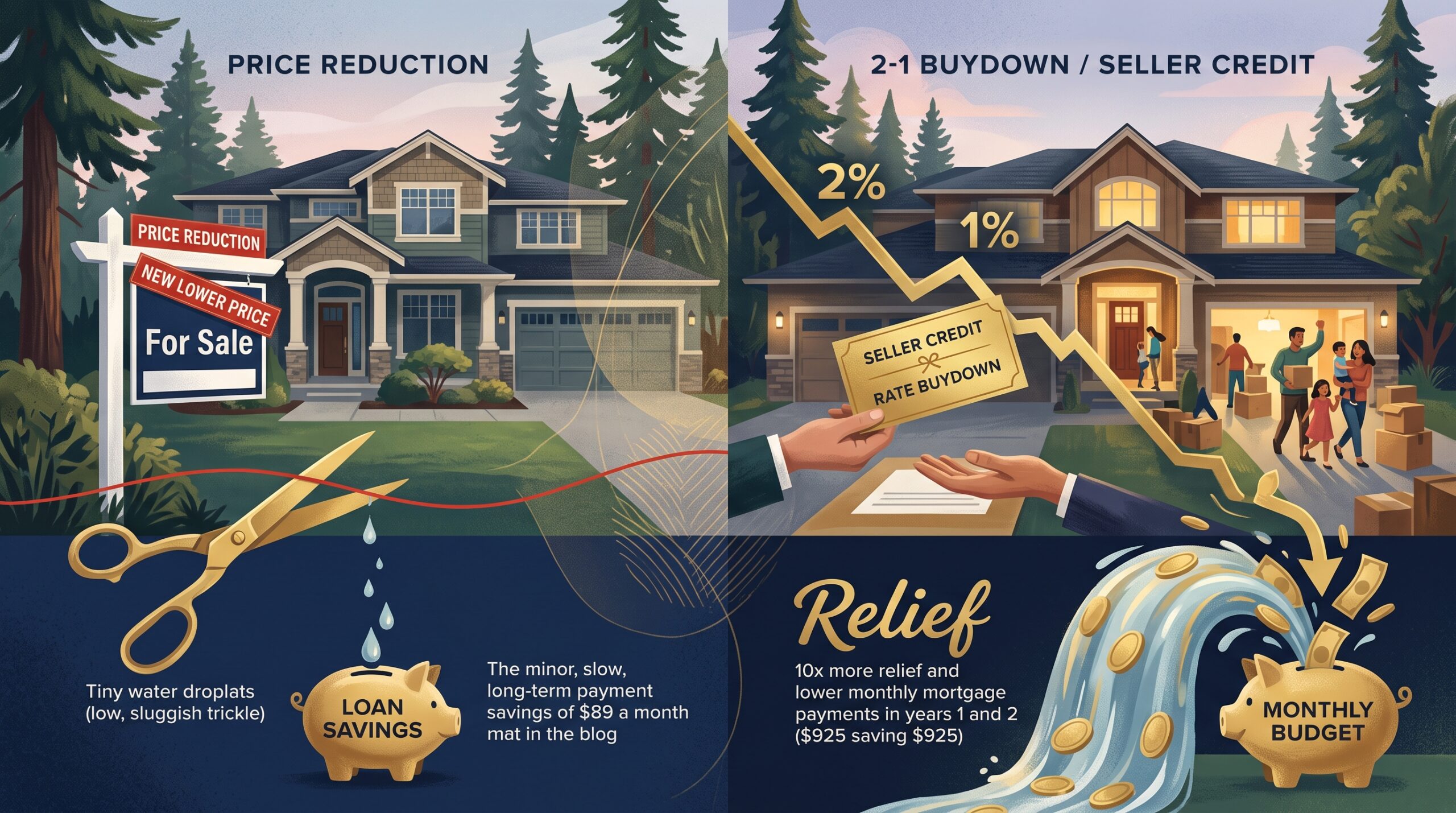
Picture a $900,000 sale on the Eastside. The seller has $16,782 to put toward closing the deal. Taken off the price, it lowers the buyer's payment by $89 a month. Spent on a 2-1 rate buydown, the same money lowers the payment by $925 a month in year one, about ten times the relief.
That money is a seller concession, often called a seller credit: money the seller puts toward the buyer's costs at closing. It appears as a credit on the settlement statement, and the buyer's lender decides how much to permit.
Most sellers I work with across Bellevue and the Eastside treat a concession as money lost. That instinct costs them. Used carelessly, it can come back from underwriting a week before closing. Used well, it is the cheapest way to make a home feel affordable to a buyer staring down a high monthly payment.
The short version
A seller-paid 2-1 buydown gives the buyer about ten times the first-year relief of an equal price cut.
A price cut only catches up after about fifteen years.
Conventional caps run 3 to 9 percent depending on the down payment. FHA allows 6 percent, and VA allows 4 percent plus normal closing costs.
At median prices with 20 percent down, Kirkland and Issaquah buyers stay conforming. Bellevue, Redmond, and Sammamish buyers go jumbo, where each lender sets its own cap.
What Are Seller Concessions in Real Estate?
Seller concessions in real estate are seller-paid contributions toward costs the buyer would normally cover. Without the jargon, the meaning is simple. The seller pays some of the buyer's bills. You will also see them called a seller credit, a seller assist, or a seller contribution. Lenders call them interested party contributions, because the money comes from someone who benefits from the sale going through.
The credit can pay closing costs and prepay property taxes and insurance. It can also cover the cost of lowering the buyer's interest rate. Can a buyer use seller concessions for the down payment? No. Fannie Mae's Selling Guide bars interested party money from the down payment and the buyer's financial reserves. It also cannot count toward the minimum contribution a buyer must make from their own funds.
There is a second limit sellers forget. The credit can never exceed the buyer's actual costs. Offer $30,000 toward $22,000 of closing costs and the extra $8,000 does not become cash in the buyer's pocket. Underwriting treats the excess as a reduction in price, or the parties have to rewrite the contract.
So a concession has two ceilings at once. One comes from the loan program. The other comes from the buyer's real costs. The lower one wins.
How Do Seller Concessions Work at Closing?
Seller concessions work as a line item in the closing paperwork. The buyer asks for a credit in the offer or during negotiation, and the agreed amount goes into the purchase agreement.
The buyer's lender then checks that number against the loan program's cap and the buyer's actual costs. Once the lender approves it, escrow applies the seller credit at closing. It shows up on the settlement statement as money moving from the seller's column to the buyer's.
Do seller concessions come out of pocket? Not usually. Escrow deducts the credit from the seller's proceeds at closing. A seller with enough equity never writes a separate check. The money comes off the bottom line instead.
Why Seller Concessions Matter on the Eastside Right Now
Eastside homes are selling below list price, and that gives buyers room to negotiate. Redfin's latest figures for Bellevue, Kirkland, Redmond, Issaquah, and Sammamish show homes closing at 97.2 to 98.0 percent of list. Days on market rose from a year earlier in every one of them.
| City | Median sale price | Sale-to-list ratio | Median days on market | Month |
|---|---|---|---|---|
| Bellevue | $1,499,286 | 97.2% | 24, up 6 | Sep 2026 |
| Kirkland | $1,290,000 | 97.8% | 22, up 6 | Aug 2026 |
| Redmond | $1,343,450 | 97.6% | 23, up 8 | Aug 2026 |
| Issaquah | $1,050,000 | 98.0% | 22, up 2 | Aug 2026 |
| Sammamish | $1,495,000 | 97.4% | 21, up 2 | Aug 2026 |
Rates add pressure. Freddie Mac put the 30-year fixed at 7.40 percent on October 8, 2026. At Eastside prices, every quarter point shows up in the monthly payment.
Resale sellers also compete with builders. Nationally, 66 percent of builders used sales incentives in September 2026, according to the NAHB/Wells Fargo Housing Market Index, and 38 percent cut prices. A buyer touring a new-construction community with an advertised buydown will notice which resale homes offer nothing.
When buyers hold the stronger hand, they ask for help. A seller who structures that help on purpose, before the first offer, controls what it costs. In my experience, the seller who waits ends up negotiating it under pressure in the inspection response.
2-1 Buydown Scenarios: The Math on Three Eastside Purchases
On each purchase below, the same dollars cut about ten times more off the first year's payment as a buydown than as a price cut. In a 2-1 buydown, the seller pays to lower the buyer's rate by two points in year one and one point in year two.
Each scenario assumes 20 percent down on a 30-year fixed loan. The 7.0 percent rate is a round illustration, not a rate quote, and the payments cover principal and interest only. Property taxes and insurance come on top, plus dues where they apply. The buydown cost is the total payment difference the seller funds over the first 24 months.
The three price points bracket the Eastside market. Scenario 1 sits below Issaquah's August median. Scenario 2 falls a little under Kirkland's. Scenario 3 lands above the medians in Bellevue and Sammamish.
At Freddie Mac's October 8 rate of 7.40 percent, the savings and the seller's cost both run about 2 percent higher than shown. The ratio between them holds.
| Scenario 1 | Scenario 2 | Scenario 3 | |
|---|---|---|---|
| Purchase price | $900,000 | $1,250,000 | $1,800,000 |
| Loan amount (20% down) | $720,000 | $1,000,000 | $1,440,000 |
| Loan type in King County | Conforming | Conforming | Jumbo |
| Payment at full 7.0% rate | $4,790 | $6,653 | $9,580 |
| Year 1 payment at 5.0% | $3,865 | $5,368 | $7,730 |
| Year 1 monthly savings | $925 | $1,285 | $1,850 |
| Year 2 payment at 6.0% | $4,317 | $5,996 | $8,634 |
| Year 2 monthly savings | $473 | $658 | $947 |
| Seller cost of the 2-1 buydown | $16,782 | $23,308 | $33,563 |
| Same amount as a price cut, monthly savings | $89 | $124 | $179 |
| Seller cost of a 1-0 buydown instead | $5,681 | $7,890 | $11,362 |
| Maximum concession allowed (conventional loan) | $54,000 | $75,000 | Set by lender |
Scenario 1 carries the opening example into year two. After the $925 drop in year one, the payment still sits $473 lower in year two. A price cut of the same size never moves it more than $89.
Scenario 2 shows a King County quirk. A $1,000,000 loan stays conforming here because the county's limit is $1,063,750. The 6 percent cap gives this seller up to $75,000 of room. The 2-1 buydown uses less than a third of it.
The jumbo case, Scenario 3, works differently. The buyer saves $1,850 a month in year one. Whether that lender permits a $33,563 credit at all is a question only the lender can answer. That is why the cap row reads "set by lender" and nothing more.
Seller Credit vs. Price Reduction: When the Price Cut Wins
A price cut is permanent, and a 2-1 buydown is gone after 24 months. That is the strongest case for a price reduction over a seller credit.
Over a long enough hold, the price cut catches up. In all three scenarios above, the monthly savings from the cut add up to the buydown's value after roughly fifteen years. The cut also lowers the buyer's down payment. On Scenario 1, a $16,800 reduction means $3,360 less cash out of the buyer's pocket at closing.
If your listing fee is a percentage of the sale price, a price cut trims that fee slightly too. A credit leaves it unchanged.
So which wins? For most buyers stretching to make the first years work, I think the front-loaded relief matters more. The fifteen-year math only pays off for a buyer who holds that exact loan for fifteen years. That is a long time.
I would cut the price instead when the home is clearly overpriced against recent sales. A concession cannot fix a bad list price. Buyers see it in the recent sales, and so does the appraiser. Our piece on pricing a Bellevue home to sell covers that side of the decision.
The Maximum Seller Concessions Allowed, by Loan Type
The maximum concession depends on the buyer's loan, not on what the seller wants to offer. On a conventional loan, it runs from 2 percent on an investment property to 9 percent for a buyer putting 25 percent down.
| Loan type | Property type | Down payment | What the credit can cover | Maximum seller concession |
|---|---|---|---|---|
| Conventional | Primary or second home | Under 10% | Closing costs, prepaid items and discount points | 3% |
| Conventional | Primary or second home | 10% to 24.99% | Closing costs, prepaid items and discount points | 6% |
| Conventional | Primary or second home | 25% or more | Closing costs, prepaid items and discount points | 9% |
| Conventional | Investment property | Any | Closing costs, prepaid items and discount points | 2% |
| FHA | Primary home | Any | Closing costs, prepaid items, discount points, rate buydowns and upfront mortgage insurance | 6% |
| VA | Primary home | N/A | Normal closing costs | No cap |
| VA | Primary home | N/A | Prepaid items, funding fee, rate buydowns and paying off the buyer's debts | 4% combined |
| USDA | Primary home | N/A | Closing costs and other fees paid for the buyer | 6% |
| Jumbo | Varies | Varies | Set by the buyer's lender | Set by lender |
Each program measures its cap against a different number. Conventional caps use the lower of the price or the appraised value. If the home appraises below the contract price, the cap shrinks with it. FHA and USDA use the sales price. VA uses the reasonable value the VA establishes for the home.
On a conventional loan, the tiers do the most damage to unprepared sellers. A buyer putting 5 percent down on a $700,000 condo can receive no more than 3 percent, or $21,000. Agree to $35,000 in the counteroffer and the deal has a $14,000 problem that nobody spots until underwriting.
FHA seller concessions are simpler, with one 6 percent cap on the sales price whatever the down payment. VA seller concessions work differently from both. Normal closing costs sit outside the 4 percent cap entirely. The cap covers the extras. Those include the VA funding fee, prepaid taxes and insurance, paying down the buyer's debts, and buying down the rate.
Paying the buyer's agent is a separate question. FHA, VA, Fannie Mae, and Freddie Mac exclude reasonable and customary commissions from their caps, so covering the buyer's agent leaves the concession room intact. USDA still counts them toward its 6 percent cap. It has proposed a change but had not finalized it as of October 2026.
Conforming or Jumbo? Where Each Eastside City Lands
King County's 2026 conforming loan limit is $1,063,750. FHFA set the national baseline at $832,750 and the high-cost ceiling at $1,249,125, and King County lands between the two.
Cross $1,063,750 and the picture changes. The buyer moves into jumbo financing, and the agency caps stop applying. Run each city's median price through that line, with 20 percent down, and the Eastside splits in two.
| City | Median sale price | Loan at 20% down | Loan type | Max seller concession |
|---|---|---|---|---|
| Bellevue | $1,499,286 | $1,199,429 | Jumbo | Set by lender |
| Kirkland | $1,290,000 | $1,032,000 | Conforming | $77,400 (6%) |
| Redmond | $1,343,450 | $1,074,760 | Jumbo | Set by lender |
| Issaquah | $1,050,000 | $840,000 | Conforming | $63,000 (6%) |
| Sammamish | $1,495,000 | $1,196,000 | Jumbo | Set by lender |
Redmond shows how thin that line is. The median buyer there lands just $11,010 over the limit. Put down about 20.8 percent instead of 20 and the same buyer stays conforming, with the full Fannie Mae cap available.
Kirkland and Issaquah sit comfortably under the line, so concession room there is predictable. Bellevue and Sammamish sit well past it.
Each jumbo lender writes its own concession rules. Some allow plenty. Some allow very little. On a jumbo purchase, the only cap that counts is the one the buyer's lender quotes. Get that number before you negotiate.
Want These Numbers Run on Your Home?
Popach & Co. prices concession options against your list price before you go live in Bellevue or anywhere on the Eastside, so you know what each structure costs you and what it does for a buyer's payment. Tell us your price range and we will show you the math.
The Ways Sellers Use Concessions
Seller concessions for closing costs are the version everyone knows. The more useful versions pay for something the buyer feels every month.
A closing cost credit covers lender fees, title insurance, escrow, and recording charges. Seller-paid closing costs lower the cash a buyer needs to close. They do nothing to the monthly payment.
A mortgage rate buydown works on the payment instead, and it comes in two forms. A temporary buydown lowers the buyer's interest rate for the first one to three years. The 2-1 from the scenarios above is one version. A 1-0 buydown discounts year one only. Fannie Mae caps the buydown period at three years, which allows a 3-2-1 structure on a fixed-rate loan.
The second form uses the credit to buy down the interest rate for good, by paying discount points at closing. The lower rate lasts for the life of the loan. Each lender prices points differently, so the buyer's lender has to quote what a given credit buys.
Credits can also prepay property taxes and homeowners insurance, two items that eat a surprising amount of a buyer's cash at closing.
On condos and townhomes, a seller can cover association costs, such as transfer fees or a capital contribution the association charges new owners. Those charges vary widely between buildings, which is one more reason how condo ownership differs from a townhouse matters before you price a unit.
Then there is the repair credit, offered after inspection in place of fixing an item yourself. Lenders handle repair credits differently, so confirm with the buyer's lender before you agree to one.
One version backfires. Sellers sometimes sweeten a deal with furniture, a car, moving costs, or a cash gift. Fannie Mae classifies those as sales concessions and deducts their value from the sales price for underwriting. Leaving the sectional behind can quietly shrink what the buyer can borrow.
How a Seller-Paid 2-1 Buydown Works for the Buyer
A buydown lowers the monthly payment, and the monthly payment is the number buyers shop on. List price gets the attention. Payment gets the decision.
One limit deserves plain language, because buyers and sellers both get it wrong. Fannie Mae requires lenders to qualify the buyer at the full note rate and to ignore the bought-down rate. A temporary buydown does not let anyone borrow more. It makes the early years cheaper for a buyer who already qualifies at the full rate.
That still matters a great deal. The first two years of homeownership are expensive in ways a mortgage calculator never shows. Buyers are still furnishing rooms and fixing the small things the inspection missed. Relief in that window is relief at the moment buyers feel stretched thinnest.
It also buys time. A buyer who expects rates to drop gets two cheaper years and a chance to refinance before the full payment arrives. Nobody can promise rates will fall, and I would never pitch a buydown on that promise.
How Much Should a Seller Offer in Concessions?
Size the concession to the structure the buyer needs, then check it against the cap. Starting from a round percentage tends to overpay for some buyers and fall short for others.
Start with the buyer's real problem. A buyer short on cash to close needs a closing cost credit, sized to their actual closing costs. A buyer worried about the monthly payment needs a buydown, and the scenario table above shows what each one costs.
The 1-0 buydown is the floor worth offering. On a $900,000 purchase it costs about $5,700 and takes a full point off year one. The 2-1 runs roughly three times that and doubles the first-year relief. Anything between the two can fund a partial credit toward closing costs instead.
Then hold it against the alternative. If the real choice is between this concession and a price cut of similar size, the scenarios show which one moves a buyer more. If you would cut the price anyway, offer the concession first and keep the cut in reserve.
Last, confirm the number fits under both the buyer's cap and their real costs. Then get it in writing from their lender before you sign.
Why Concessions Draw Buyers In
Concessions reach a buyer the price tag cannot, one who can carry the payment but is short on cash to close. Down payment plus closing costs is the cash a buyer has to bring, and a closing cost credit lowers that number directly.
Concessions also give the buyer's agent something concrete to sell. When two similar homes sit at similar prices, the one with a funded buydown hands that agent a monthly payment to quote. That is a far easier conversation than "they might come down."
Offers You Can Structure With Concessions
The simplest structure is full price with a closing cost credit. The seller holds the headline number, and the buyer brings less cash to the table.
A step up from that is full price with a seller-funded 2-1 buydown. The buyer gets the payment relief shown above, and the contract price stays intact.
My favorite is the menu. The seller offers one fixed dollar amount. The buyer decides how to split it between closing costs and a rate buydown. Buyers with tight cash take the credit. Buyers with tight monthly budgets take the buydown.
After inspection, a repair credit can replace a repair. It saves the seller from managing a contractor during escrow. Clear it with the buyer's lender first.
Some buyers propose a higher price with a matching credit back to them. It looks neutral for the seller, and it is close. Still, a higher contract price means a higher excise tax, and a higher listing fee if yours is a percentage. The bigger risk is the appraisal. The home still has to appraise at the higher price, and lenders measure the cap against the lower of price or appraised value. If the appraisal comes in short, the whole structure unravels.
When several offers arrive, compare them on net, before excise tax and fees. An offer at $1,500,000 with a $30,000 credit nets the same as a clean $1,470,000. A clean offer at $1,480,000 beats both by $10,000, even though its headline price is lowest.
Concessions can also reward speed. A seller who needs a fast close can tie a credit to a closing date, paying the buyer to move on the seller's timeline.
Strategies That Put Your Home Ahead of the Competition
Price the buydown with a lender before the home goes live. A seller who can say exactly what a credit buys the buyer looks prepared. A seller who offers "help with closing costs" looks vague.
Advertise the concession, but carefully. Federal truth-in-lending rules treat the amount of any payment as a trigger term. Put "$3,865 a month" in a listing and the ad must also disclose the down payment, the repayment terms, and the annual percentage rate. "Seller-paid rate buydown available" carries none of that burden. Coordinate any payment figure with a lender before it appears anywhere.
Offer the concession before you cut the price. Give the market a window with the credit in place. If the home still sits, a price reduction remains available later, and you have not lowered the headline number on day one.
Match the offer to the buyer's loan. In Kirkland and Issaquah, a median-priced buyer with 20 percent down is conforming, so the cap is predictable. Elsewhere, from Bellevue to Sammamish, that same buyer is jumbo and the cap depends on one lender's rules.
Price against new construction as well as resale. If a builder nearby advertises a buydown, a buyer will set your home beside it. A funded 1-0 or 2-1 buydown lets a resale home answer that comparison directly.
On a condo, lead with the association costs. Covering a capital contribution or a few months of dues speaks straight to what condo buyers worry about most. That worry is the monthly carrying cost stacked on top of the mortgage.
Are Seller Concessions Tax Deductible?
Partly. Seller-paid points can be deductible for the buyer, and seller-paid loan charges count as a selling expense for the seller. Washington adds two wrinkles of its own.
On the buyer's side, Publication 936 treats points the seller pays as if the buyer paid them. The buyer can deduct those points if they meet the IRS tests. The buyer must also reduce their basis in the home by the same amount.
The seller cannot deduct those points as interest. Instead, IRS Publication 523 counts mortgage points or other loan charges a seller pays, when they would normally be the buyer's responsibility, as selling expenses. Selling expenses lower your amount realized, and that lowers your taxable gain.
That only matters if your gain exceeds the exclusion. Publication 523 lets most owners exclude up to $250,000 of gain on a main home, or $500,000 for a married couple filing jointly. Owned your Eastside home long enough to clear that? Have a tax professional run the numbers before you agree to a large concession.
Washington's capital gains tax stays out of it. The Department of Revenue lists real estate among the exemptions.
The real estate excise tax is the open question. It runs on the selling price, which state rules presume equals the total consideration paid. Those rules do not address seller credits directly.
A price cut lowers the selling price, so it lowers the excise tax for certain. On a $1,500,000 sale, a $30,000 price cut trims the state portion by $384. Whether a seller credit does the same is a question for your escrow officer before you choose between the two. That $384 is small next to what the same $30,000 does as a buydown, but it belongs in the comparison.
Mistakes That Cost Sellers Money
The most common one is agreeing to a concession before knowing the buyer's loan type. Sellers anchor on a dollar figure and sign the counteroffer. Then underwriting reveals a lower cap.
Inflating the price to fund a credit is the second. It works only if the appraisal cooperates, and appraisers do not care what the contract says.
Throwing in personal property is the third, for the underwriting reason covered above. And promising a specific payment in marketing without the required disclosures is a compliance problem that no seller wants attached to a listing.
Concessions also count among the costs of selling. The full cost of selling in Bellevue puts them beside everything else that comes out of your proceeds.
Popach & Co. builds concession strategy into every listing plan for sellers across Bellevue and the Eastside, from the first pricing conversation through the final counteroffer. You can see how we present homes in our current Popach & Co. listings.
Sell With a Concession Plan That Holds Up
Mark Popach has worked the Bellevue market for close to a decade. Popach & Co. sizes every concession to the buyer's loan, prices it with a lender, and keeps it inside the cap so nothing comes back at underwriting.
Sources and disclaimer: Loan limits: Fannie Mae B3-4.1-02 and B2-1.4-04, FHA, VA, USDA (proposed rule), FHFA 2026. Market data: Redfin (Bellevue, Kirkland, Redmond, Issaquah, Sammamish), Freddie Mac, NAHB. Tax: IRS Publications 523 and 936, WA capital gains, WAC 458-61A-102, WA excise tax. Advertising: 12 CFR 1026.24. Payment scenarios use a hypothetical 7.0 percent rate and show principal and interest only. Market figures reflect the months shown, and loan limits update each year. This article is not legal, tax, or lending advice; confirm current rules with the buyer's lender and qualified counsel.