A building-by-building comparison of amenities, HOA dues, and real proximity to work and transit. Written by someone who has toured all five and sat through the HOA disclosures.
Updated August 2026 | By Mark Popach, Bellevue Realtor at Popach & Co.
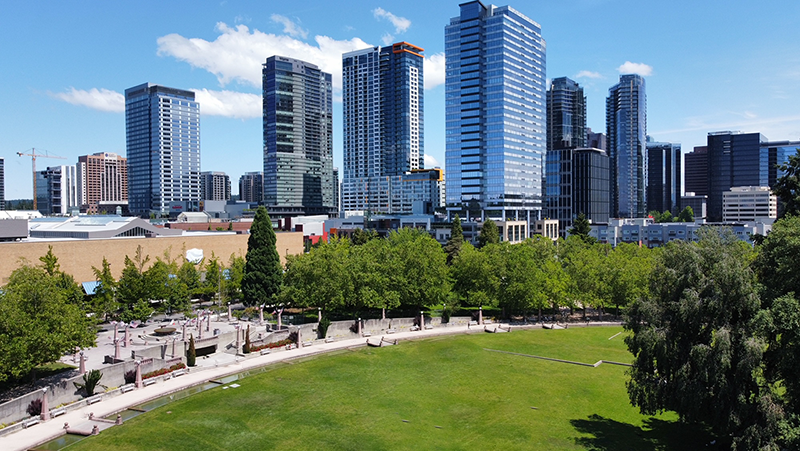
I have walked buyers through Bellevue Tower, Washington Square, One Lincoln Tower, The Bravern, and The Avenue more times than I can count. There is a question I hear in almost every one of them. "Wait, don't they all have a pool and a concierge?" Yes, they do. At this price point, a fitness center and a 24-hour front desk stopped being a selling point around 2015. They are just the entry fee now. If you compare these buildings on their amenity checklists alone, you will come away thinking they are interchangeable. They are not. The differences that actually change your daily life are quieter than a "resort-style pool." They come down to three things. How far you are really walking to the train. What your HOA dues are buying you per square foot. And whether the building is bolted onto a shopping center or standing on its own.
This is the comparison I wish existed before I had to build it myself. It came from five separate building tours and three HOA disclosure packets. Add in a lot of walking around Bellevue's high-rise condo market with a phone in one hand, tracking the minutes.
Why this matters more than it used to: Sound Transit's 2 Line finally runs uninterrupted from Seattle through Bellevue to Redmond as of March 2026. For years, "close to light rail" was a marketing phrase pointed at a station that did not fully connect anywhere. Now it does. A five-minute difference in walk time to Bellevue Downtown Station is no longer trivial. It is the difference between riding the train to work most days and never touching it.
1. The Amenity Checklist That Tells You Less Than You Would Think
Here is the honest version of the comparison everyone starts with. All five buildings sit within Bellevue's downtown core, close enough to each other that you could walk the whole loop in under twenty minutes.
| Building | Signature Amenities |
|---|---|
| Bellevue Tower | Full-service concierge, private fitness center, indoor pool with sauna and hot tub, secured underground parking, floor-to-ceiling windows |
| Washington Square Towers | Concierge and secured access, fitness center, indoor pool and spa area, large balconies, generous storage. The most residential feel of the group. |
| One Lincoln Tower | Concierge, resident lounges, modern fitness center, sauna and hot tub access through the connected complex, direct tie-in to Lincoln Square retail and dining |
| The Bravern Residences | Private resident lobby separate from retail, full concierge, fitness center, spa-inspired wellness amenities, elevator-access secure parking |
| The Avenue Bellevue | Full-service concierge and valet, resort-style pool, spa, sauna and fitness center, hotel-inspired resident services, panoramic Lake Washington and mountain views |
Notice the repetition. Concierge, five for five. Fitness center, five for five. Sauna or spa-style wellness, five for five. If you pick a building on this table alone, you are picking on noise. The real signal is in what each building is physically attached to. One Lincoln Tower and The Bravern are wired directly into retail centers: Lincoln Square and The Shops at The Bravern. Your amenities quietly extend into restaurants and grocery you never drive to. Bellevue Tower and Washington Square are standalone towers, quieter and more private. The amenities stay inside the building rather than spilling into a mall downstairs.
2. What Your HOA Dues Are Actually Buying You
Nobody talks about this part. It is the part I would want to know before I fell in love with a view. Downtown Bellevue high-rise HOA dues typically run $600 to $1,200 a month, with some buildings pushing past $1,800 for larger units. That is not a rounding error on your monthly cost. On a $1.2M condo, a $1,200 monthly HOA fee is roughly equivalent to carrying an extra $200,000 of mortgage. Lenders count it that way when they calculate your debt-to-income ratio, and you should too.
Where I have been able to verify per-square-foot HOA rates, they land somewhere in this range:
| Building | Approx. HOA Rate | What It Is Doing |
|---|---|---|
| Washington Square Towers | ~$0.52/sq. ft. | Standard mid-rise operating budget: concierge, pool, fitness, no shared retail infrastructure to subsidize |
| Bellevue Tower | ~$0.53/sq. ft. | Comparable to Washington Square, funding a similar standalone amenity package |
| One Lincoln Tower | ~$0.67/sq. ft. | Higher rate, but the pool is shared with the adjacent Westin, so you are partly funding hotel-grade wellness infrastructure most standalone buildings cannot offer |
Rates above are estimates from third-party HOA data sources, not the buildings' current financial disclosures, and can shift with each budget cycle. I do not have verified current per-square-foot figures for The Bravern or The Avenue Bellevue. Both should be confirmed directly from the HOA resale certificate before you write an offer.
The takeaway is not "cheaper is better." A higher HOA rate sometimes buys you something real, like One Lincoln Tower's shared access to Westin-grade pool infrastructure. Sometimes it just means the reserve fund is playing catch-up on deferred maintenance in a building a decade older than its neighbors. The only way to tell the difference is to actually read the reserve study, not the dues number. I have seen buyers walk away from a great unit because the HOA fee looked high in isolation. The real story was a building that had fully funded its reserves. It was never going to hit them with a special assessment in year three. I have also seen the opposite: a low HOA fee that turned out to be a warning sign, not a bargain.
The question that matters more than the dues amount: Ask for the last three years of reserve study updates, not just the current one. A dues number that has been flat for five years in a twenty-year-old building is a red flag, not a selling point. It usually means the increases are coming, all at once, as a special assessment.
Not Sure How to Read a Reserve Study? I Will Walk You Through It.
Send me the resale certificate for any unit you are considering. I will tell you, in plain language, whether the reserves are healthy or whether a special assessment is coming. Get the answer before you get emotionally attached to the unit.
3. Proximity: Transit, Work, and the Things You Will Actually Walk To
| Building | Transit Access | Proximity to Employers | Proximity to Events |
|---|---|---|---|
| Bellevue Tower | ~5–8 min walk to Bellevue Downtown Station (2 Line) | Short walk to Amazon's downtown campus (Dynamo, Sonic, Bellevue 600). Microsoft Redmond is ~5 stops, ~10 min on the 2 Line. | Close to Bellevue Downtown Park and Meydenbauer Center. A few blocks to Bellevue Square. |
| Washington Square Towers | ~8–10 min walk to Bellevue Downtown Station | Comfortable walk to Amazon's core buildings. Same ~10 min 2 Line ride to Redmond Technology Center. | Walkable to Bellevue Square and Lincoln Square. Near Bellevue Downtown Park. |
| One Lincoln Tower | ~5 min walk to Bellevue Downtown Station | Very short walk to Amazon's downtown towers. Same 2 Line access to Redmond. | Attached to Lincoln Square (dining, movie theater, event space). Short walk to Meydenbauer Center. |
| The Bravern Residences | ~10–12 min walk to Bellevue Downtown Station or East Main Station | Short walk to Amazon's campus. A few minutes farther from the 2 Line than the three buildings above. | Built into The Shops at The Bravern (Neiman Marcus, high-end dining). Close to Meydenbauer Center. |
| The Avenue Bellevue | ~6–8 min walk to Bellevue Downtown Station | Central downtown location, a walk to Amazon comparable to Bellevue Tower's. | Steps from Bellevue Square and downtown dining. Near Bellevue Downtown Park. |
Walk times are estimates based on each building's downtown block relative to the nearest station or campus entrance. Actual routes, elevators, and lobby time will add a few minutes. Verify the real walk before letting it decide anything.
What "close to the train" is actually worth now
For years, "steps from light rail" was aspirational marketing copy pointing at a station under construction. That changed on March 28, 2026, when the 2 Line finally connected Seattle to Bellevue to Redmond as one continuous ride. From Bellevue Downtown Station, it is roughly 20 minutes to International District/Chinatown Station in Seattle. From there, you can connect toward the University of Washington or the airport. Head the other way and Redmond Technology Center, a short walk from Microsoft's main campus, is a handful of stops out. For a two-income household with one partner working in Seattle and the other at Microsoft, that single train line now covers both commutes. Two years ago, it covered neither.
Bellevue Tower, One Lincoln Tower, and The Avenue Bellevue have the shortest walks to the station, generally under ten minutes. Washington Square and The Bravern run a few minutes longer. That gap sounds small on paper. It stops sounding small the first week you do it in February rain with a laptop bag.
Work: Amazon is next door, Microsoft is a train ride, not a drive
Amazon's downtown Bellevue campus clusters around 106th to 108th Avenue NE, a few blocks from the transit center. That includes Dynamo, Sonic, Bellevue 600, and Amazon Everest. Every building in this comparison puts Amazon within an easy 10-to-15 minute walk. That matters given the roughly 14,000 Amazon employees now based in Bellevue. That number has climbed steadily even as the company's Seattle headcount has shrunk. Microsoft's Redmond campus is not walkable from any of these five buildings, and it never will be. But the completed 2 Line turns it into a real transit commute instead of a guaranteed fight with I-405. That is a genuine shift from where things stood even two years ago.
If your commute decides this for you: Prioritize buildings within a ten-minute walk of Bellevue Downtown Station. Bellevue Tower, One Lincoln Tower, and The Avenue Bellevue lead here. If you are walking to an Amazon office and rarely touching the train, the gap between all five buildings mostly disappears. Every one of them sits within a comfortable walk of the downtown Amazon campus.
Events: what is actually in walking distance, not just in the brochure
Downtown Bellevue earns its reputation on events. The walk to them varies more than people expect. Meydenbauer Center hosts conventions, concerts, and community events, and it sits close to the station. Bellevue Tower, One Lincoln Tower, and The Bravern are all a short walk away. Bellevue Downtown Park, with its summer concert series and seasonal programming, sits closest to Bellevue Tower, Washington Square, and The Avenue. If you count retail as entertainment, which in downtown Bellevue is a fair argument, One Lincoln Tower and The Bravern win outright. They are physically connected to Lincoln Square and The Shops at The Bravern.
4. Matching a Building to How You Actually Live
| If you want... | Consider |
|---|---|
| The shortest possible walk to light rail and Amazon | One Lincoln Tower or Bellevue Tower |
| A quieter, more residential feel without leaving downtown | Washington Square Towers |
| Retail and dining built into the building itself | One Lincoln Tower (Lincoln Square) or The Bravern (The Shops at The Bravern) |
| The most polished, hotel-style service experience | The Avenue Bellevue |
| Discretion and a lower-profile, executive crowd | Bellevue Tower or The Bravern Residences |
None of these five is a wrong answer. All five have proven HOAs and active resale markets. All five share the baseline amenity package (concierge, fitness, secure parking, wellness) that defines this segment of the Bellevue market. What actually separates them is quieter than the sales sheet. It comes down to how much you weight a short walk to the train against a calmer building. It also comes down to how much you value having a mall downstairs versus a lobby that is just a lobby.
What I tell buyers who are stuck between two of these: Weight HOA reserve health and building reputation above the specific amenity list. The pool and the sauna are easy to compare on a spec sheet. Whether the building has actually held up over a decade is not easy to compare on paper. Neither is whether the HOA board has been funding reserves honestly instead of kicking the can. Both matter far more to your resale value five years from now.
5. What to Verify Before You Write an Offer
A comparison post is a starting point. It is not a substitute for actually reading the documents. Before you write an offer on any Bellevue high-rise condo, get your hands on the items below.
| Verify This | Why It Matters |
|---|---|
| The HOA reserve study, three years of it | A flat dues number in an older building is often a warning sign of an assessment coming, not a bargain |
| The actual walk time, measured yourself | "Steps from light rail" means different things in different listings. Walk the route before you assume a five-minute commute. |
| Parking allocation, unit by unit | This varies even within the same building. Confirm exactly how many deeded or assigned spots come with your specific unit. |
| Whether shared amenities are mid-renovation | Some buildings are months into a pool or lobby renovation that will not show up until you ask directly |
Ready to Walk Through a Few of These Buildings?
Reading about a sauna and standing in one are two different things. I can set up back-to-back tours of whichever buildings you are weighing. You can compare them in the same afternoon, with someone in the room who has actually sat through every one of these HOA disclosures. I can tell you what the sales rep will not.
Free. No obligation. No sales pressure, just a straight comparison.
Amenity information compiled from building marketing materials and Popach & Co.'s own building coverage as of August 2026. HOA rate estimates are drawn from third-party listing data, not verified current financial disclosures, and should be confirmed against each building's resale certificate before purchase. Transit walk times are approximate, based on downtown block locations relative to Sound Transit's 2 Line stations. Full Seattle-to-Redmond service began on March 28, 2026. Confirm exact routes and times if commute time is a deciding factor. Amenity availability, HOA fees, and building policies are subject to change. Verify current details directly with each building's HOA or listing agent before purchasing.