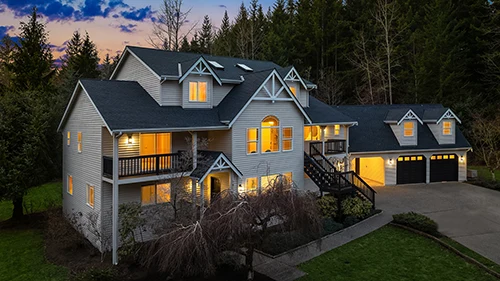
Redmond is the most misread city on the Eastside. Buyers who have not lived here assume it is a bedroom community for Microsoft employees and not much else. What they find when they start looking seriously is a city with genuine neighborhood depth, a trail and outdoor access network that is better than anything Bellevue or Kirkland offers at a comparable price point, and a housing market that rewards buyers who understand its internal logic.
The challenge is that most buyers approaching Redmond for the first time are also comparing it against Bellevue and Kirkland simultaneously. They are trying to solve for commute, schools, lifestyle, and long-term value all at once, often while managing a relocation timeline that does not leave room for mistakes. Getting that decision right requires understanding what Redmond actually is, not what it looks like on a map.
Why Microsoft campus proximity matters more than most buyers account for
The Microsoft main campus in Redmond is the largest private employer on the Eastside by a significant margin, and the proximity advantage it creates for Redmond buyers is real and measurable. Employees who live in Redmond's core neighborhoods, particularly Education Hill, Grass Lawn, and the areas immediately west of the campus, are typically 10 to 15 minutes from their desk without touching the 520 or 405 corridors. That is not a small quality-of-life difference. It compounds over years.
Buyers who work at Microsoft and choose Bellevue or Kirkland for lifestyle reasons often underestimate the cumulative time cost. A 25-minute commute each way adds up to roughly 200 hours per year. Mark has worked with Microsoft employees who relocated from Bellevue to Redmond after two years because the commute math finally outweighed the lifestyle preference they had initially prioritized. Starting with an honest assessment of how much that time is worth to you shapes every other decision in the search.
For buyers at Amazon, Google, or Meta, the calculus reverses. Amazon's Spring District offices in Bellevue and Google's Kirkland campus create commute disadvantages from Redmond that buyers should model carefully. If you work at Google, Redmond puts you on the wrong side of Kirkland every day. If you work at Amazon's Bellevue offices, you are navigating 520 or surface streets through Kirkland to get there. The employer-to-city match is not a minor consideration. It is often the decision.
How Redmond prices compared to Bellevue and Kirkland
Redmond's median home price sits meaningfully below both Bellevue and Kirkland's waterfront-influenced medians, typically in the $1.1 to $1.4 million range for quality single-family homes in core neighborhoods. That spread is not because Redmond is a weaker market. It reflects the absence of a waterfront premium and a different buyer composition. Redmond draws a higher proportion of buyers who are optimizing for commute and schools rather than lifestyle amenities, which creates more stable pricing but less of the emotional premium that waterfront access generates in Kirkland.
The practical implication for buyers is that the same dollar goes further in Redmond than in comparable West Kirkland or West Bellevue neighborhoods. A $1.4 million budget in Redmond delivers substantially more square footage, larger lots, and newer construction than the same budget in Kirkland's waterfront corridor. For buyers who are not specifically chasing lake access, this is a meaningful advantage that is easy to overlook when neighborhood comparisons are done on price per square foot alone.
For buyers comparing all three cities, the Bellevue vs Kirkland guide covers the Bellevue-Kirkland decision in detail. Redmond sits in a third position that is distinct from both: lower entry price, stronger commute advantage for Microsoft employees, and a different lifestyle profile that suits a specific buyer type very well.
Buying in Redmond and Not Sure Where to Start?
Mark works with buyers across Redmond, Bellevue, and Kirkland and can give you a straight read on which city and which neighborhood actually fits your situation. Visit the Redmond WA real estate agent page to see how he works with Redmond buyers, or call directly.
Call or text Mark directly: (425) 297-3088
Redmond neighborhoods: what each one actually delivers
Education Hill is Redmond's most consistently strong residential neighborhood. It sits on elevated terrain northwest of downtown with views toward the Cascade foothills, feeds into Redmond's top-rated elementary schools, and is close enough to the Microsoft campus to make daily commutes straightforward without highway exposure. Homes here tend to be established, well-maintained, and competitively priced relative to the quality of what they deliver. Buyers who prioritize school access and commute time and are not specifically attached to lakeside living land here and tend to stay.
Grass Lawn sits closer to the Microsoft campus and draws a high concentration of tech buyers who want the shortest possible commute window. The neighborhood is quieter and more suburban in character than Education Hill, with good access to Grass Lawn Park and the Bear Creek trail system. It is an underrated choice for buyers who want space and proximity without paying waterfront premiums.
Redmond Ridge is the city's newer construction corridor, sitting east of downtown toward the Sammamish plateau. Homes here are larger, newer, and more affordable per square foot than core Redmond neighborhoods, but the commute to the Microsoft campus runs longer and the neighborhood character is more suburban sprawl than established community. It suits buyers who prioritize space and new construction over walkability and proximity.
Downtown Redmond and the Overlake corridor are where the city is evolving fastest. The Link light rail extension to Redmond brought meaningful infrastructure investment and is reshaping buyer interest in walkable, transit-adjacent properties near the city center. Buyers who are open to a more urban Redmond experience and are willing to be early to a neighborhood that is still developing will find compelling opportunities here at prices that have not yet caught up to what the infrastructure investment implies for long-term value.
Trails, parks, and the outdoor access premium
Redmond's trail network is genuinely exceptional and directly relevant to home values in a way that is easy to quantify. The Sammamish River Trail runs through the city connecting Redmond to Bothell in one direction and Marymoor Park in the other. Marymoor itself is one of the largest and most well-used parks in King County, hosting concerts, sports facilities, a dog park, and direct trail connections to the broader regional network.
Homes within walking distance of the Sammamish River Trail carry a measurable premium above comparable homes that require driving to trail access. Mark has tracked this premium at roughly 4 to 7 percent above the neighborhood median for homes with direct trail adjacency, a figure that does not appear in standard automated valuations but shows up consistently in final sale prices when the right buyers are competing.
For buyers who use trail access regularly, either for commuting by bike to the Microsoft campus or for recreational use, proximity to the trail system is a functional amenity that has real dollar value. Treating it as a lifestyle bonus rather than a pricing factor is a mistake that leads to undervaluing trail-adjacent homes and missing opportunities that more informed buyers close on.
Ready to See What Redmond Has to Offer?
Browse Redmond homes for sale to see current inventory across Education Hill, Grass Lawn, Redmond Ridge, and downtown. Then call Mark for a neighborhood-level read on what each area is actually delivering for buyers at your price point right now.
Call or text Mark directly: (425) 297-3088
What relocating buyers consistently get wrong about Redmond
Buyers relocating to the Eastside for the first time almost always underestimate Redmond and overestimate the importance of having a Bellevue or Kirkland address. The address preference is real but it is largely social. The underlying fundamentals of schools, commute, lifestyle access, and long-term value do not consistently favor Bellevue or Kirkland over Redmond for buyers whose primary employer is Microsoft and whose priorities are a reasonable commute, strong schools, and access to outdoor amenities.
The second consistent mistake is treating the Eastside as one undifferentiated market and searching based on price range without understanding neighborhood-level dynamics. A $1.3 million budget in Redmond, Kirkland, and Bellevue delivers three very different purchases. The buyer who does not understand that difference before they start touring ends up either overpaying for location they do not use or discovering after closing that the commute or school situation is not what they expected.
The buyers who navigate this best are the ones who do the city comparison before they fall in love with a specific house. Once a buyer is emotionally attached to a property, the city-level tradeoffs become harder to evaluate objectively. Mark works with buyers across Redmond, Kirkland, and Bellevue, and the early conversation about which city actually fits tends to save buyers from the more expensive conversation about why they chose the wrong one. The real estate agents in Bellevue at Popach & Co. cover all three markets and can run that comparison honestly before you commit to a search area.
What Microsoft's hybrid work shift has done to Redmond buyer demand
The shift to hybrid work schedules at Microsoft changed the Redmond buyer demand pattern in a way that is not yet fully reflected in how most buyers think about the market. When five-day-a-week office attendance was standard, the commute proximity advantage of Education Hill and Grass Lawn was the dominant factor for Microsoft buyers. With two or three days per week now common, some buyers have expanded their search radius under the assumption that commute matters less.
What Mark has observed in practice is more nuanced. Buyers who go hybrid and move to Bellevue or Kirkland for lifestyle reasons often find that the days they do commute become disproportionately disruptive, particularly on the mandatory in-person days when the entire team is on campus simultaneously and traffic on 520 and the Redmond connector peaks. The commute math changes but does not disappear, and buyers who factor in only the number of commute days rather than the quality of those commutes sometimes end up with the same frustration their fully in-office predecessors had.
The more durable effect of hybrid work in Redmond has been on the Overlake and downtown corridor specifically. Buyers who are partially remote and want walkability on their off-campus days have driven increased interest in properties near the light rail stations and the revitalized downtown core. Streets within a half-mile of the Redmond Technology Station on the Link extension have seen price per square foot appreciation outpace the broader Redmond market over the past 18 months, and that trend has further to run as the surrounding retail and dining infrastructure continues to develop.
Start Your Redmond Home Search the Right Way
Whether you are a Microsoft employee trying to optimize your commute, a relocating buyer evaluating the Eastside for the first time, or a move-up buyer comparing Redmond against Kirkland and Bellevue, Popach & Co. works across all three markets and can give you a straight read on where your specific situation fits best. The first conversation is free.
Call or text Mark directly: (425) 297-3088
Free. No obligation. No sales pressure.