Most buyers who lose offers in Bellevue do not lose because they were outbid on price. They lose because their offer was structurally weaker than the one that won, and they never knew it.
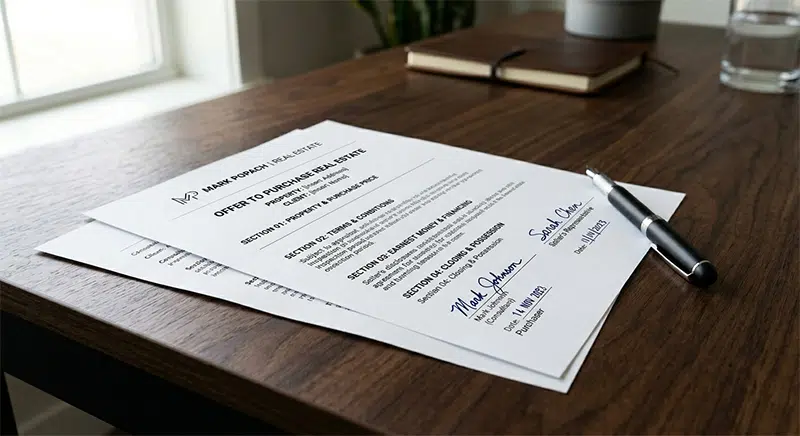
Price is visible. Everything else in an offer, including terms, contingencies, timeline, and the way the offer is written and presented, is where the real competition happens.
In a market where multiple offers are common and listing agents are reading between the lines of every submission, the difference between winning and losing is often in the details that buyers and their agents either get right or get wrong.
Why price alone does not win offers here
Bellevue sellers are sophisticated. Many of them have owned in this market for years, have watched it closely, and have a realistic sense of what their home is worth. An offer that comes in dramatically above list price does not automatically feel like a win to them. It raises questions. Is the buyer emotionally overextended? Will this appraise? Will they walk if there is any friction during inspection?
A well-constructed offer at a competitive but not reckless price, with clean terms and a seller-friendly closing timeline, often outperforms a higher offer with weak structure. Mark has seen offers $30,000 higher than his client's lose to a cleaner package because the listing agent advised the seller that the higher offer carried more risk.
The goal is not to offer the most. The goal is to be the offer the seller is most confident will close on the terms they care about.
Pre-approval versus pre-underwriting: the gap most buyers miss
Most buyers show up to a Bellevue offer situation with a standard pre-approval letter. That letter tells the seller that a lender has reviewed the buyer's income and credit and thinks they qualify. It does not tell the seller that the loan is solid.
Pre-underwriting goes further. It means the lender has actually reviewed the buyer's full file, including tax returns, bank statements, and employment verification, and has conditionally approved the loan pending only the specific property. A buyer who shows up with a pre-underwritten approval is telling the seller that the financing risk is substantially reduced. In a multiple-offer situation, that distinction matters. Mark has seen listing agents advise sellers to take offers $15,000 to $20,000 lower from pre-underwritten buyers because the certainty of close outweighed the difference in price.
Ask your lender specifically whether they offer pre-underwriting. Not all do. The ones that do give buyers a meaningful advantage in competitive Eastside markets.
Want to Know How Strong Your Offer Position Is?
Before you write your next offer, talk to Mark. He will tell you exactly where you stand competitively in your target neighborhoods and what your offer structure needs to look like to win. Visit Bellevue WA Real Estate to learn more about how he works.
Call or text Mark directly: (425) 297-3088
Escalation clauses: when they help and when they backfire
An escalation clause tells the seller that you will beat any competing offer by a set increment, up to a maximum price. On paper it sounds like a smart hedge. In practice it depends entirely on how the listing agent runs the offer process and what the seller values.
In a transparent multiple-offer situation where the listing agent shares competing offer prices, an escalation clause can work well. You set a reasonable increment above competing offers and a ceiling you are comfortable with, and you let the clause do the work.
But not every listing agent runs a transparent process. Some will not disclose competing prices at all, which makes your escalation clause unverifiable. Others actively dislike escalation clauses because they complicate the review process and can feel opportunistic to sellers who prefer clean, committed offers. In those situations, a clear best offer with a strong price and clean terms will outperform a clause every time.
The right call depends on the property, the listing agent, and the competitive environment. Getting that read wrong can cost you the home or cost you money you did not need to spend. This is where having an agent who knows the listing agents in these neighborhoods is worth significantly more than the commission they earn.
Contingencies: what to waive, what to keep, and what the risk actually is
The pressure to waive contingencies in a competitive market is real. Sellers prefer clean offers. But waiving the wrong contingency on the wrong property can be one of the most expensive decisions a buyer makes.
The inspection contingency is the one buyers are most often pressured to waive. In some situations, particularly on newer construction or a property that has been recently and credibly renovated, a pre-offer inspection is worth considering. You pay for and complete the inspection before submitting your offer, which lets you waive the contingency with full information. You know what you are buying. That is a very different risk profile than waiving inspection blind on a 1970s home with no disclosure of work done.
The financing contingency is a different calculation. Waiving it means that if your loan falls through for any reason, you lose your earnest money. For buyers who are genuinely pre-underwritten and confident in their financing, this is a manageable risk. For buyers who are at the edge of their qualification or in a complex income situation, it is not.
The appraisal contingency sits in between. Waiving it means you commit to paying your offer price even if the property appraises below it. In Bellevue's market, where prices are high and appraisals can lag behind fast-moving sale data, this gap comes up more than most buyers expect. Consider what it looks like in practice: you offer $1.65M on a home, it appraises at $1.58M, and your lender will only loan against the appraised value. If you waived the appraisal contingency, you are covering that $70,000 gap in cash or losing your earnest money by walking. For buyers with significant liquidity above their down payment, this is a manageable risk. For buyers stretched to their limit, it is not, and agreeing to waive it in the heat of a competitive moment without fully understanding the math is one of the most common and costly mistakes buyers make in this market.
Not Sure What to Waive on Your Next Offer?
Mark walks every buyer through exactly this conversation before they submit. What contingencies make sense, what the risk profile looks like for the specific property, and what the competitive environment requires. Start with the buying a home in Bellevue page to see how he approaches buyer representation.
Call or text Mark directly: (425) 297-3088
Terms that sellers care about that buyers routinely overlook
Closing timeline is one of the most underused levers in a Bellevue offer. Most offers default to 30 days, but many Bellevue sellers are simultaneously buying their next home and have a specific timeline they are working around. Mark makes it a standard part of his process to call the listing agent before every offer and ask directly what the seller needs. It takes five minutes and the information it produces is often the difference between a winning offer and a near miss. A seller who needs 45 days because their next home is not ready will sometimes pass on a higher offer from a buyer insisting on a 30-day close. A seller who has already found their next place and wants out in 21 days will do the same in reverse. Matching that timeline costs the buyer nothing and signals exactly the kind of preparation sellers respond to.
The earnest money amount is another lever. The standard in Bellevue is typically 1 to 3 percent of the purchase price. A buyer who puts up 5 percent is signaling commitment in a way that a standard deposit does not. It tells the seller that this buyer is serious, financially capable, and not looking for an easy exit. In a close decision between two similar offers, earnest money can be the tiebreaker.
A personal letter from the buyer used to be a common tactic in this market. It still comes up, but most experienced listing agents in Bellevue actively discourage sellers from reading them, and with good reason. Beyond the fair housing concerns, letters tend to backfire practically. They introduce emotional variables into a financial decision, and sellers who get swayed by a letter sometimes end up in a deal with a buyer whose offer structure was weaker than the one they passed on. The buyers who win in Bellevue are the ones who let the offer speak for itself: clean terms, strong financing, a timeline that works for the seller, and an earnest money amount that signals commitment rather than optionality.
What listing agents actually want from your buyer's agent
This is the part of the offer process that buyers almost never think about and almost always matters. Listing agents talk to each other. The Eastside real estate community is not as large as it looks from the outside, and a buyer's agent who has a reputation for difficult transactions, poor communication, or creating problems during due diligence is a liability to their client in a competitive situation.
A listing agent who has worked with Mark before knows that his offers are clean, his clients are prepared, and that when he says something will happen it happens. That reputation does not appear on a listing sheet. It is built over years of transactions in the same market, with the same people, and it shows up at exactly the moment it matters most.
When you are evaluating which agent to use for your Bellevue home search, ask them directly: do you know the listing agents who are most active in the neighborhoods I am targeting? The answer will tell you a great deal about how much of the market they actually work.
Ready to Put Together a Stronger Offer?
Browse Bellevue homes for sale to see what is currently available, then talk to Popach & Co. about what a competitive offer looks like in your specific target neighborhoods. The first conversation is free.
Call or text Mark directly: (425) 297-3088
Free. No obligation. No sales pressure.